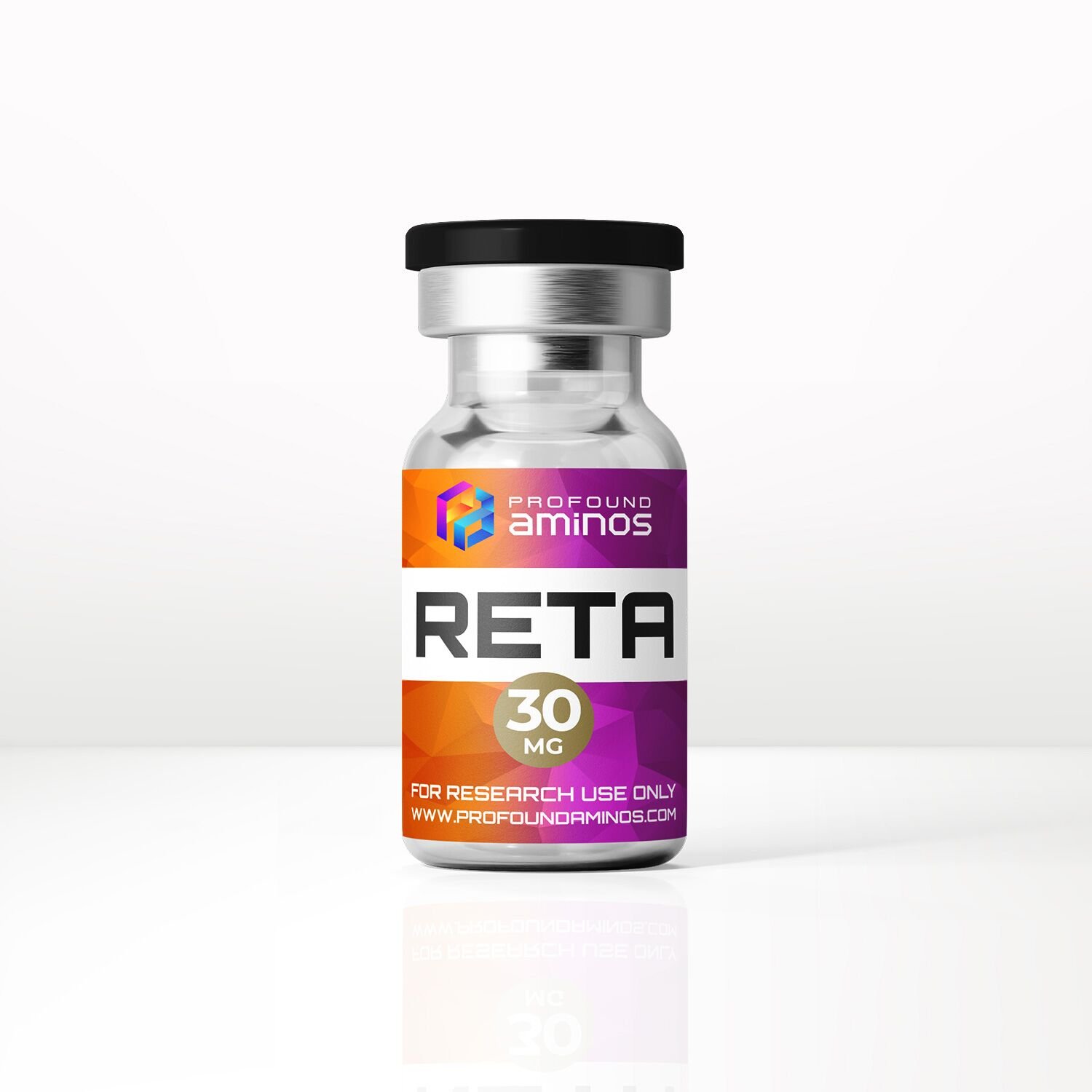
Reta
Price range: $69.00 through $269.00
Reta Research Grade (RUO) (CAS 2381089-83-2, LY3437943) is a 39–amino acid unimolecular peptide designed as a triple agonist for GIP / GLP-1 / Glucagon (GCG) receptors. Supplied as a lyophilized white powder with ≥99% purity (HPLC verified) and endotoxin <1.0 EU/mg, it is soluble in sterile or bacteriostatic water.
The molecule includes a C20 fatty diacid moiety for albumin binding and extended stability (reported ~6-day half-life), supporting metabolic, obesity, T2D, and hepatic defatting research models.
For Research Use Only (RUO). Not for human or veterinary use.
Reta (RUO) | Triple GIP/GLP-1/Glucagon Agonist | ≥99% Purity
Product Specifications
- Product Name : Reta (Research Grade)
- CAS Number : 2381089-83-2
- Common Name : LY3437943
- Molecular Formula : C221H342N46O68
- Molecular Weight : 4731 g/mol
- Peptide Type : Triple-Hormone Receptor Agonist
- Target Receptors : GIP / GLP-1 / Glucagon (GCG)
- Purity : ≥99% (HPLC Verified)
- Form : Lyophilized White Powder
- Solubility : Soluble in sterile water or bacteriostatic water
- Endotoxin Level : Less than 1.0 EU/mg
Disclaimer : For Research Use Only (RUO). Not for human use.
Chemical Identity & Structural Mechanism
Reta is a synthetic unimolecular peptide comprising 39 amino acids. Unlike dual agonists, it integrates activity at the Glucagon Receptor (GCGR) alongside GIP and GLP-1, creating a “Triple Synergy”.
Structure-Activity Relationship (SAR): The backbone is derived from GIP but modified to introduce Glucagon activity. It features a C20 fatty diacid moiety that binds to albumin, protecting the peptide from enzymatic degradation and extending its half-life to approximately 6 days.
Tuned Potency: Reta is designed with a specific hierarchy of potency: highest at GIP (for lipid buffering), moderate at GLP-1 (for satiety), and carefully tuned at Glucagon (to drive energy expenditure without hyperglycemia) .
Chemical structure of Reta (LY3437943)
A simplified 2D chemical structure visualization of Retatrutide (LY3437943) displayed as a peptide-like chain with numerous functional groups and side chains. The graphic is used for compound identification and reference in research documentation related to GIP/GLP-1/glucagon receptor triple agonist studies (RUO).
” data-image-caption=”
2D structural diagram of Retatrutide (LY3437943), a research-grade triple agonist peptide.
” data-large-file=”https://profoundaminos.com/wp-content/uploads/2024/10/Retatrutide-LY3437943-2D-Molecular-Structure-1024×1024.webp” alt=”2D molecular structure diagram of Retatrutide (LY3437943), a peptide-based triple agonist, showing the backbone chain with multiple side groups.” width=”300″ height=”300″ sizes=”auto, (max-width: 300px) 100vw, 300px” nitro-lazy-srcset=”https://licensebpeptides.com/wp-content/uploads/2026/06/Retatrutide-LY3437943-2D-Molecular-Structure-300×300-1.webp 300w, https://cdn-iledacd.nitrocdn.com/SjFAtUDKoxpKJBWpudFZVunbmeIDeGio/assets/images/optimized/rev-859d9ce/profoundaminos.com/wp-content/uploads/2024/10/Retatrutide-LY3437943-2D-Molecular-Structure-1024×1024.webp 1024w, https://cdn-iledacd.nitrocdn.com/SjFAtUDKoxpKJBWpudFZVunbmeIDeGio/assets/images/optimized/rev-859d9ce/profoundaminos.com/wp-content/uploads/2024/10/Retatrutide-LY3437943-2D-Molecular-Structure-150×150.webp 150w, https://cdn-iledacd.nitrocdn.com/SjFAtUDKoxpKJBWpudFZVunbmeIDeGio/assets/images/optimized/rev-859d9ce/profoundaminos.com/wp-content/uploads/2024/10/Retatrutide-LY3437943-2D-Molecular-Structure-768×768.webp 768w, https://cdn-iledacd.nitrocdn.com/SjFAtUDKoxpKJBWpudFZVunbmeIDeGio/assets/images/optimized/rev-859d9ce/profoundaminos.com/wp-content/uploads/2024/10/Retatrutide-LY3437943-2D-Molecular-Structure-700×700.webp 700w, https://cdn-iledacd.nitrocdn.com/SjFAtUDKoxpKJBWpudFZVunbmeIDeGio/assets/images/optimized/rev-859d9ce/profoundaminos.com/wp-content/uploads/2024/10/Retatrutide-LY3437943-2D-Molecular-Structure-500×500.webp 500w, https://cdn-iledacd.nitrocdn.com/SjFAtUDKoxpKJBWpudFZVunbmeIDeGio/assets/images/optimized/rev-859d9ce/profoundaminos.com/wp-content/uploads/2024/10/Retatrutide-LY3437943-2D-Molecular-Structure-100×100.webp 100w, https://cdn-iledacd.nitrocdn.com/SjFAtUDKoxpKJBWpudFZVunbmeIDeGio/assets/images/optimized/rev-859d9ce/profoundaminos.com/wp-content/uploads/2024/10/Retatrutide-LY3437943-2D-Molecular-Structure.webp 1500w” nitro-lazy-src=”https://licensebpeptides.com/wp-content/uploads/2026/06/Retatrutide-LY3437943-2D-Molecular-Structure-300×300-1.webp” class=”size-medium wp-image-91700 nitro-lazy” decoding=”async” nitro-lazy-empty id=”MjQ1ODoxNDU5-1″ data-nitro-empty-id=”MjQ1ODoxNDU5-1″ src=”https://profoundaminos.com/data:image/svg+xml;base64,PHN2ZyB2aWV3Qm94PSIwIDAgMzAwIDMwMCIgd2lkdGg9IjMwMCIgaGVpZ2h0PSIzMDAiIHhtbG5zPSJodHRwOi8vd3d3LnczLm9yZy8yMDAwL3N2ZyI+PC9zdmc+”>
a triple-hormone receptor agonist (GIP/GLP-1/Glucagon). The highlighted C20 fatty acid moiety facilitates albumin binding, extending the half-life to ~6 days for sustained metabolic research.
Why Leading Labs Source Reta from Profound Aminos
The Business of Reliability: Ensuring Reproducible Results in Metabolic Research.
Successful research demands consistency. It is a complex, acylated peptide that degrades rapidly if mishandled. We don’t just sell peptides; we safeguard your data integrity through rigorous operational standards.
1 – Lot-Specific Transparency (The “Zero-Doubt” Standard)
We eliminate the “black box” of reagent sourcing. Every vial of Reta comes with actionable proof of quality:
Verified Structural Integrity: Our COA explicitly confirms the presence of the critical C20 fatty acid side chain—the specific component responsible for the 6-day half-life. Without this, your long-duration studies will fail.
Purity Guarantee: HPLC analysis confirming ≥99% purity ensures your results are driven by the molecule, not impurities.
2 – USA-Based Cold-Chain Logistics (Potency Protection)
Reta’s “Triple G” mechanism is powerful but fragile. Thermal stress causes hydrolysis of the acylated side chain, rendering the peptide useless.
Standard Storage: While others ship from overseas warehouses, our stock is maintained at -20°C in our USA facility.
Immediate Potency: We ship directly to your lab, minimizing transit time and thermal exposure. You receive a research-ready molecule, not a degraded byproduct.
3 – The “Triple G” Advantage (Invest in Superior Efficacy)
Why settle for dual agonists? Reta offers the highest ROI (Return on Investigation) in the market today :
Mechanism: GIP + GLP-1 + Glucagon (The Differentiator).
The Edge: By sourcing true “Triple G” Reta, you unlock the ability to study energy expenditure and hepatic defatting (>86%) simultaneously—capabilities that Tirz and Sema cannot offer.
Advantage: Reta vs. Competitors
Reta fundamentally changes the energy balance equation by targeting both Energy Intake (EI) and Energy Expenditure (EE). Unlike earlier peptides that only suppress appetite, Reta actively burns calories via Glucagon activation.
| Parameter | Reta (Triple) | Tirz (Dual) | Sema (Mono) |
|---|---|---|---|
| Mechanism | GIP / GLP-1 / Glucagon | GIP / GLP-1 | GLP-1 |
| Weight Loss (High Dose) | ~24% – 29% | ~21% | ~15% |
| Liver Fat Reduction | >86% (Defatting) | Moderate | Low |
| Metabolic Focus | Appetite + Caloric Burn | Appetite Suppression | Appetite Suppression |
Research Context & Clinical Insights (2025-2026)
Obesity & Osteoarthritis (TRIUMPH-4) :
In Phase 3 trials released in Dec 2025, Reta 12 mg demonstrated a mean weight reduction of 28.7%. More importantly, it achieved a 75.8% reduction in knee pain scores, proving its benefits extend beyond simple weight loss to structural and inflammatory improvements.
Type 2 Diabetes (TRANSCEND-T2D-1) :
Reta is currently under active investigation in clinical trial NCT06354660. This pivotal study evaluates the effect of Reta vs. placebo in adult participants with Type 2 Diabetes who have inadequate glycemic control, aiming to replicate the massive weight loss seen in non-diabetic cohorts.
Hepatic Health (MASLD Defatting) :
In Phase 2 substudies, >90% of subjects with metabolic dysfunction-associated steatotic liver disease (MASLD) achieved normalization of liver fat (<5%). This data positions Reta as the leading candidate for reversing hepatic steatosis 2.
Endotoxin Monitoring :
Screened to <1.0 EU/mg to ensure suitability for high-sensitivity metabolic assays.
Regulatory & Compliance Statement
FDA Status : Reta is currently an Investigational New Drug (IND) in Phase 3 clinical trials (TRIUMPH & TRANSCEND series). It is not FDA-approved.
WADA Status : Prohibited under S2 (Peptide Hormones).
Usage : Strictly for Laboratory Research Use Only (RUO). Not for human use, diagnostic, or clinical procedures.
Frequently Asked Questions :
Q: Why is Reta considered the “Gold Standard” over Tirz and Sema for obesity research?
A: Reta represents a paradigm shift from “treatment” to “medical bariatrics.” While Sema peaks at ~15% weight loss and Tirz at ~21%, Reta has demonstrated a staggering 28.7% mean body weight reduction in Phase 3 trials. For researchers, this molecule offers the highest therapeutic ceiling currently available, effectively mimicking surgical outcomes through pharmacotherapy alone.
Q: Does Reta offer distinct advantages for Type 2 Diabetes (T2D) modeling compared to dual agonists?
A: Absolutely. Reta is not just a weight-loss agent; it is a metabolic powerhouse. In T2D trials, it achieved the largest weight reduction ever reported in a diabetic population (~17% vs typical 13%) while delivering HbA1c reductions of up to 2.0%15. This makes it the superior candidate for studying the reversal of “diabesity” and restoring normoglycemia in insulin-resistant models.
Q: How does the “Triple Agonist” mechanism drive superior ROI (Return on Investment) in metabolic studies?
A: The addition of the Glucagon (GCG) receptor is the “blockbuster” differentiator. Unlike GLP-1/GIP agonists that primarily suppress energy intake, Reta attacks obesity on two fronts: it lowers intake and actively increases energy expenditure (thermogenesis) via glucagon signaling. This unique mechanism resolves the “metabolic adaptation” plateau often seen with older peptides.
Q: With such potent Glucagon activity, is there a risk of hyperglycemia in research subjects?
A: This is a common misconception. Reta utilizes a “tuned” potency ratio where the robust insulinotropic effects of GIP and GLP-1 fully counterbalance the glucagon component. Clinical data confirms improved glycemic control (lower HbA1c) despite glucagon activation, proving it safely harnesses the fat-burning benefits of glucagon without the diabetic downside.
Q: Is the molecule stable enough for long-duration preclinical trials?
A: Yes. Reta is engineered with a C20 fatty diacid moiety that promotes albumin binding, extending its half-life to approximately 6 days18. This structural stability supports convenient weekly administration protocols, reducing variable stress on subjects compared to daily peptides. Profound Aminos ensures this stability is maintained via -20°C cold-chain logistics.
Be the first to review “Reta”
Related products
Uncategorized
Uncategorized
Uncategorized
Uncategorized
Uncategorized
Uncategorized
Uncategorized
Uncategorized
Reviews
There are no reviews yet.